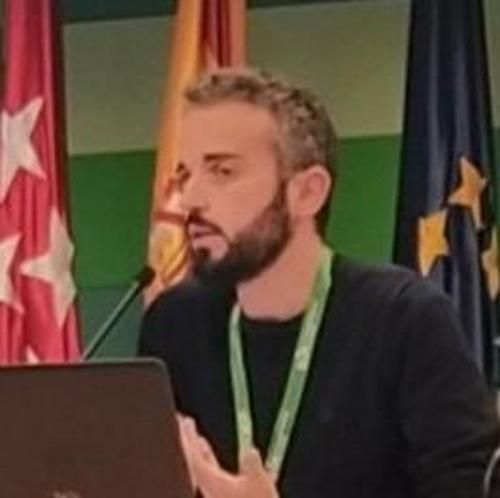
Carlos SANZ SIMÓN
Profesor ayudante doctor
Department: Estudios Educativos
Faculty: Educación-Centro Formación Profesor
Centre/Institute: Instituto de Investigaciones Feministas
Area: Theory and History of Education
Research group: CEGI Claves históricas y comparadas de la educación. Género e identidades
Email: csa02@ucm.es
Personal web: https://educacion.ucm.es/carlos-sanz-simon
Phone: +34 91 394 61 95
Address: Facultad de Educación - Centro de Formación del Profesorado, C/Rector Royo Villanova, 1, 28040 Madrid (España)
Doctor by the Universidad Complutense de Madrid with the thesis Identidad, alteridad y nacionalismo los procesos de nacionalización en la enseñanza primaria de España e Italia desde una perspectiva transnacional (1931-1959) 2020. Supervised by Dr. Juri Meda, Dr. Teresa Rabazas Romero.
Carlos Sanz Simón is an Assistant Professor (Profesor Ayudante Doctor) in the Department of Educational Studies (Area of Theory and History of Education) at the Complutense University of Madrid. At this institution, he earned his Bachelor’s Degree in Pedagogy (2015) and his Master’s Degree in Educational Research (2016). In 2020, he obtained his Ph.D. in Education with international distinction and received the Extraordinary Doctoral Award. His doctoral studies were supported through a competitive predoctoral research fellowship funded by the Complutense University of Madrid and Banco Santander. In addition, he has been affiliated with the Complutense Museum of Education since 2014, has been a member of the research group “Historical and Comparative Keys to Education: Gender and Identities” since 2016, and has been part of the Chair for Studies on the Segovia School and Pedagogical Renewal since 2023 —contexts within which he has developed his main lines of research. His academic trajectory has been further enriched through national and international research stays at institutions such as the Università degli Studi di Macerata (2018), the University of Valladolid (2023), and Macquarie University of Sydney (2025), as well as teaching mobilities under the Erasmus+ programme at the Università degli Studi di Macerata (2019) and the Humboldt Universität zu Berlin (2023). His research focuses on the history of education from diverse perspectives, including the study of nationalism, the Primary Education Inspectorate, school culture and classroom practices, historical-educational heritage, and the history of women’s education in various contexts. Within these areas, he has authored numerous articles and book chapters in both national and international journals and publishing houses, including Revista de Educación (2020, 2025), Paedagogica Historica (2019), and Historia y Memoria de la Educación (2019, 2020, 2023), among others. He has also presented the results of his research at national and international academic meetings focused on the history and heritage of education, such as the Conferences of the Spanish Society for the History of Education (SEDHE, since 2017), the Scientific Conferences of the Spanish Society for the Study of Historical-Educational Heritage (SEPHE, since 2018), and the Annual Conferences of the International Standing Conference for the History of Education (ISCHE, since 2019). Furthermore, he has been invited to participate in academic events dedicated to research dissemination and knowledge transfer, including the II International Congress “Transformations and (In)Consistencies of Educational Dynamics: The (Trans)National, the Local and the Community in Educational Policies” (Coimbra, 2017), the International Symposium “Women and Education in the Public Eye in the 19th and 20th Centuries” (Umeå, 2024), and the 9th Nordic Educational History Conference (Stockholm, 2025). He has taken part in several competitive research projects, such as “School Renewal and Tradition in Spain through Photography (1900–1970)” (Spanish Ministry of Economy, Industry and Competitiveness); “Totalitarianisms and the Inner Exile of Women Educators in Spain (1923–1975): Silences, Resistances, and Re-significations” (Spanish Ministry of Science and Innovation); “The Professional Selection Courses (1931–1936): A Comparative Study, from a Gender Perspective, of Teacher Training during the Second Republic” (Spanish Ministry of Science and Innovation); and “The Imperative of Educational Innovation: Analysis of Its Reception and Articulation in the Spanish Education System” (Spanish Ministry of Science and Innovation). He currently serves on the Editorial Board of Cabás. International Journal of Historical-Educational Heritage and the Assistant Editorial Board of Paedagogica Historica. International